NEWS & REVIEWS
Stay up to date with C&B News.
Workplace Mental Health & Well-Being
Psychology has much to offer to the discussion of well-being in the workplace. The US Department of Health and Human Services recent focus on workplace mental health and well-being echos the American Psychological Association’s conversation on how to enhance well-being in the workplace. Key components are: 1. Safety from psychological harm, 2. Improvements in one’s sense of mattering to those around them and 3. Feeling as if one’s work has meaning. If your workplace is having difficulties in these areas consult a psychologist for help.
-JEANNINE MONNIER, PH.D.
How AI is Reshaping Work and Human Psychology
Struggling with integrating AI into your workplace? You are not alone. The adoption of any new technology can lead to disruption in the workplace. This article by Paul Tsagaroulis, Ph.D., explores how to adopt AI in consideration of how it will be received by the people using it, so as to maximize positive gains and minimize the potential for harm.
Workers are facing an age of uncertainty
Despite ongoing stressors, psychological science can help both employers and employees navigate the changing landscape in workplace productivity, efficiency and satisfaction. In this article by the American Psychological Association, principles grounded in behavioral science research, such as “mattering," can help organizations create conditions that foster trust and resilience, laying the groundwork for healthier, human-valued, productive workplaces.
-CINDY CARTER, PH.D.
Speaking of Psychology: How do you build a successful team? With Eduardo Salas, PhD
Common myths of team leadership are dispelled in this “Speaking of Psychology” podcast by the American Psychological Association. Eduardo Salas, Ph.D. discusses new psychological science examining key elements in building effective teams.
-CINDY CARTER, PH.D.
Movement to include mental health providers on health care teams is coming into its own
Psychologists wrestle with the use of artificial intelligence (AI) in the practice of psychology. This American Psychological Association (APA) article covers relevant areas on this topic. It compliments C&B's recent podcast on the topic:
-Jeannine Monnier, Ph.D.
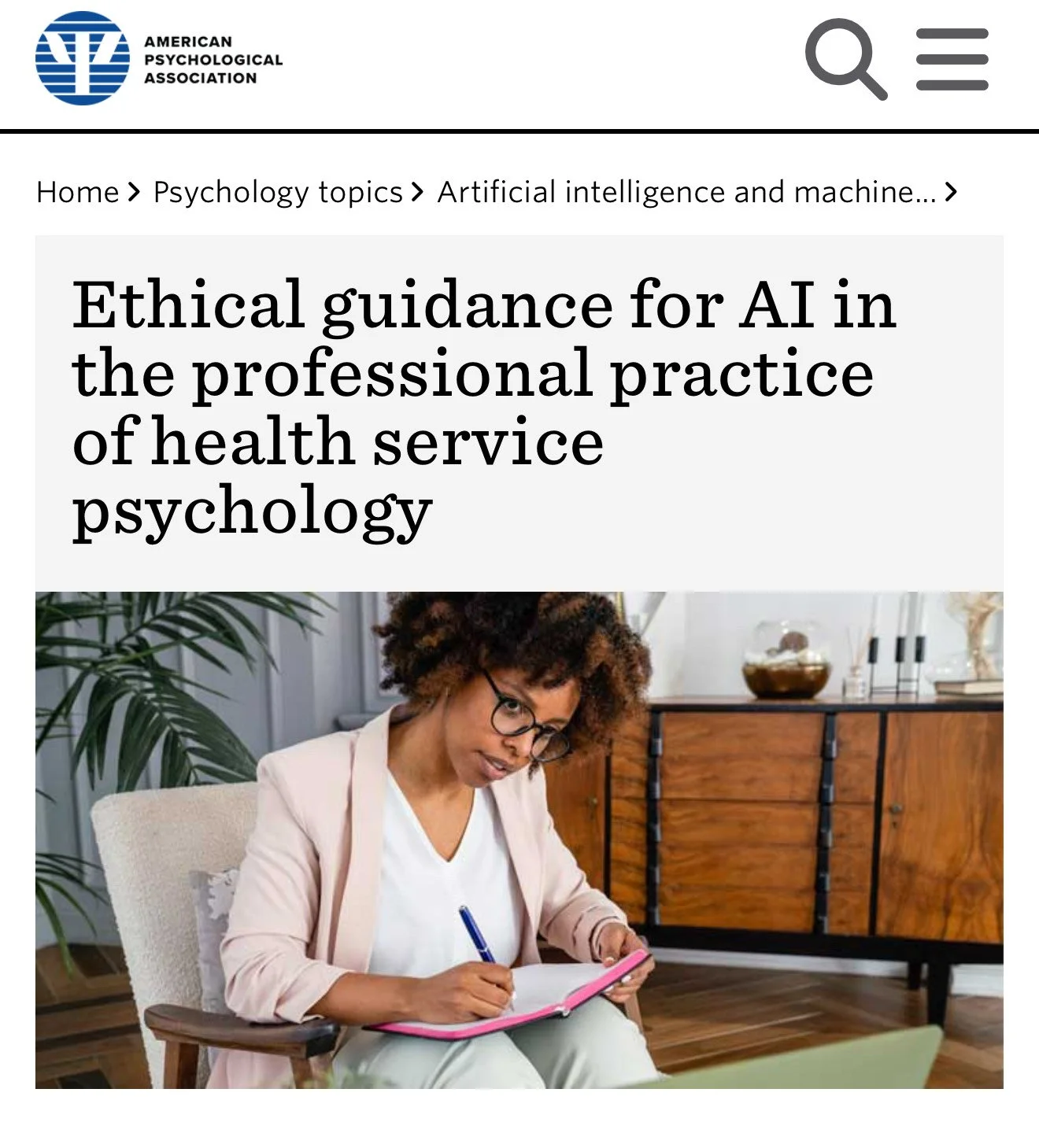
Ethical guidance for AI in the professional practice of health service psychology
Psychologists wrestle with the use of artificial intelligence (AI) in the practice of psychology. This American Psychological Association (APA) article covers relevant areas on this topic. It compliments C&B's recent podcast on the topic:
-Jeannine Monnier, Ph.D.

PSYCHOLOGY OF STRATEGIC LEADERSHIP: UNVEILING COGNITIVE BIASES AND EMOTIONAL INFLUENCE
As our study of the gut increases, we are gaining a better understanding of how the food we consume impacts not only our bodies but or minds as well. New evidence links the consumption of sugary drinks to depression through the impact these drinks have on the gut microbiome. Further, these effects seem to be more significant for women. More reasons to eat healthy!
Jeannine Monnier, Ph.D.
Link here and in bio-
#MentalHealthAwareness #GutBrainConnection #MindBodyHealth #HealthyMindHealthyBody #NutritionAndMentalHealth #GutHealthMatters #FoodAndMood #EmotionalWellness #HolisticMentalHealth #EatForYourMind #MentalWellness #MindBodyConnection #HealthyHabits #WellbeingJourney #PositiveMentalHealth

APA calls for guardrails, education, to protect adolescent AI users
As our study of the gut increases, we are gaining a better understanding of how the food we consume impacts not only our bodies but or minds as well. New evidence links the consumption of sugary drinks to depression through the impact these drinks have on the gut microbiome. Further, these effects seem to be more significant for women. More reasons to eat healthy!
Jeannine Monnier, Ph.D.
Link here and in bio-
#MentalHealthAwareness #GutBrainConnection #MindBodyHealth #HealthyMindHealthyBody #NutritionAndMentalHealth #GutHealthMatters #FoodAndMood #EmotionalWellness #HolisticMentalHealth #EatForYourMind #MentalWellness #MindBodyConnection #HealthyHabits #WellbeingJourney #PositiveMentalHealth
APA calls for guardrails, education, to protect adolescent AI users
As artificial intelligence (AI) descends on us all, we should be thoughtful about how our children interface with it. The American Psychological Association has put together a report related to helping parents, educators, etc. consider the wide ranging impact of this technology on developing brains and provide guidance on how adolescents can use AI safely.
Link here- https://www.apa.org/news/press/releases/2025/06/protect-adolescent-ai-users
#ArtificialIntelligence #AIandKids #HealthyTechUse #ChildDevelopment #DigitalParenting #PsychologyMatters #APAGuidance #TechSafety #RaisingDigitalNatives #MindfulTech #SafeAI #ParentingInTheDigitalAge #EducatorsGuide #AdolescentHealth #AIImpact
Evidence-Based Vaccination Resources
For those who have questions about vaccinations, Dr. Lepkowsky of the American Psychological Association has compiled helpful links to evidence-based articles on the topic.
Jeannine Monnier, Ph.D.
Licensed Clinical Psychologist
Co-Director
See these links for more information: https://jamanetwork.com/journals/jama/article-abstract/2838491?guestAccessKey=bf866c9f-4180-490d-9519-ee78b90e6215&utm_medium=email&utm_source=postup_jn&utm_campaign=article_alert-jama&utm_content=olf-tfl_&utm_term=083025
https://www.medicareresources.org/faqs/does-medicare-cover-the-covid-vaccine-and-boosters/
APA poll finds younger workers feel stressed, lonely and undervalued
The American Psychological Association surveyed over 2,000 working adults in the US to check in on their attitudes towards work in the 2024 Work in America survey. Findings indicate that younger workers are having some difficulty fitting in and that workers are likely to feel lonely at work. The survey also found that AI is being used more often than employers are advocating and that most employees surveyed are interested in a four-day workweek. See the article for other interesting findings.
Boost Your Brain: How Behavioral Health Can Help Prevent Dementia
Check out this article in the Post and Courier! Research confirms that behavioral health interventions can help reduce the risk of developing dementia. Hopefully, this news will inspire more people to get moving—both physically and cognitively!
Understanding anticipatory anxiety during key life transitions
‘Tis the season of life transitions with many people graduating and moving on to the next chapter of their lives. Transitions often bring with them stress and anxiety about the “what ifs,” which is also known as anticipatory anxiety. Unfortunately, anticipatory anxiety impacts the brain similarly to how an actual threat impacts the brain, which can lead to distress and avoidance. In this Monitor on Psychology article by Charlotte Huff, anticipatory anxiety is explained and helpful strategies for managing it are presented.
New Study Reveals Millions of Young Americans Provide Essential Care to Adults
This study from researchers at John Hopkins University indicates that millions of young Americans, ages 15-22, are providing essential caregiving to adults in their family. The research reveals that youth caregivers are more likely to be non-white and face educational disadvantages compared to their non-caregiving peers. Spending less time on educational activities can have long-term implications for academic achievement and economic stability. For more on this topic, consider reading an opinion piece recently published in the Journal of Mental Health and Clinical Psychology on the “hidden” population of adolescent female Hispanic caregivers.
-CINDY CARTER, PH.D.

Mental Health Disparities Among LGBTQ People in the US—Time to End the Stigma
There has been much talk recently about LGBTQ+ matters and some significant changes in access to literature and research funding that might help us to better understand human differences. Such knowledge would work to greatly reduce human suffering (see above article on mental health disparities in the LBGTQ+ community). PRIDE Month is a great time to reflect on how to improve awareness and find similarities instead of creating divisions.
-JEANNINE MONNIER, PH.D.

The changing marijuana landscape: What you need to know
The changing landscape of cannabis use is keeping psychologists on their toes. Read more about where we are with our understanding of how cannabis impacts the brain and directions in treatment related to cannabis use and dependency in this article from the American Psychological Association’s Monitor on Psychology.
-JEANNINE MONNIER, PH.D.

Biological Markers Identified for Teen Depression
While diagnosing depression relies mostly on self-reported symptoms, McGill University researchers have identified nine molecules in the blood of depressed teens that have not previously been linked to adult depression. Although follow-up studies are needed, a blood-based screening tool could pave the way to earlier detection and treatment for at-risk youth.
-CINDY CARTER, PH.D.

From 38% to 25%: Drop in 'Excellent' Mental Health Among U.S. Mothers
A recent study reveals a significant drop in self-reported "excellent" mental health among U.S. mothers—from 38.4% in 2016 to just 25.8% in 2023. Single moms, those with lower education, and publicly insured children are most affected. It's a wake-up call for better support systems.
– Jeannine Monnier, Ph.D.

June is Post-Traumatic Stress Disorder (PTSD) Awareness Month.
June is Post-traumatic Stress Disorder (PTSD) Awareness Month. The U.S. Department of Veterans Affairs offers comprehensive information on the disorder, including treatment options and advice for family and friends. Check it out and spread the word: Trauma happens, psychologists can help.
– Jeannine Monnier, Ph.D.

The essential role of human factors psychology in technology design
The central figure in most product design projects is the human. What happens when technology designers do not test out products on humans to assess for ease of use, safety, etc. before going to production? This article discusses recents examples of projects that left out human factors psychologists, resulting in significantly negative outcomes.
Jeannine Monnier, Ph.D.